Schedule
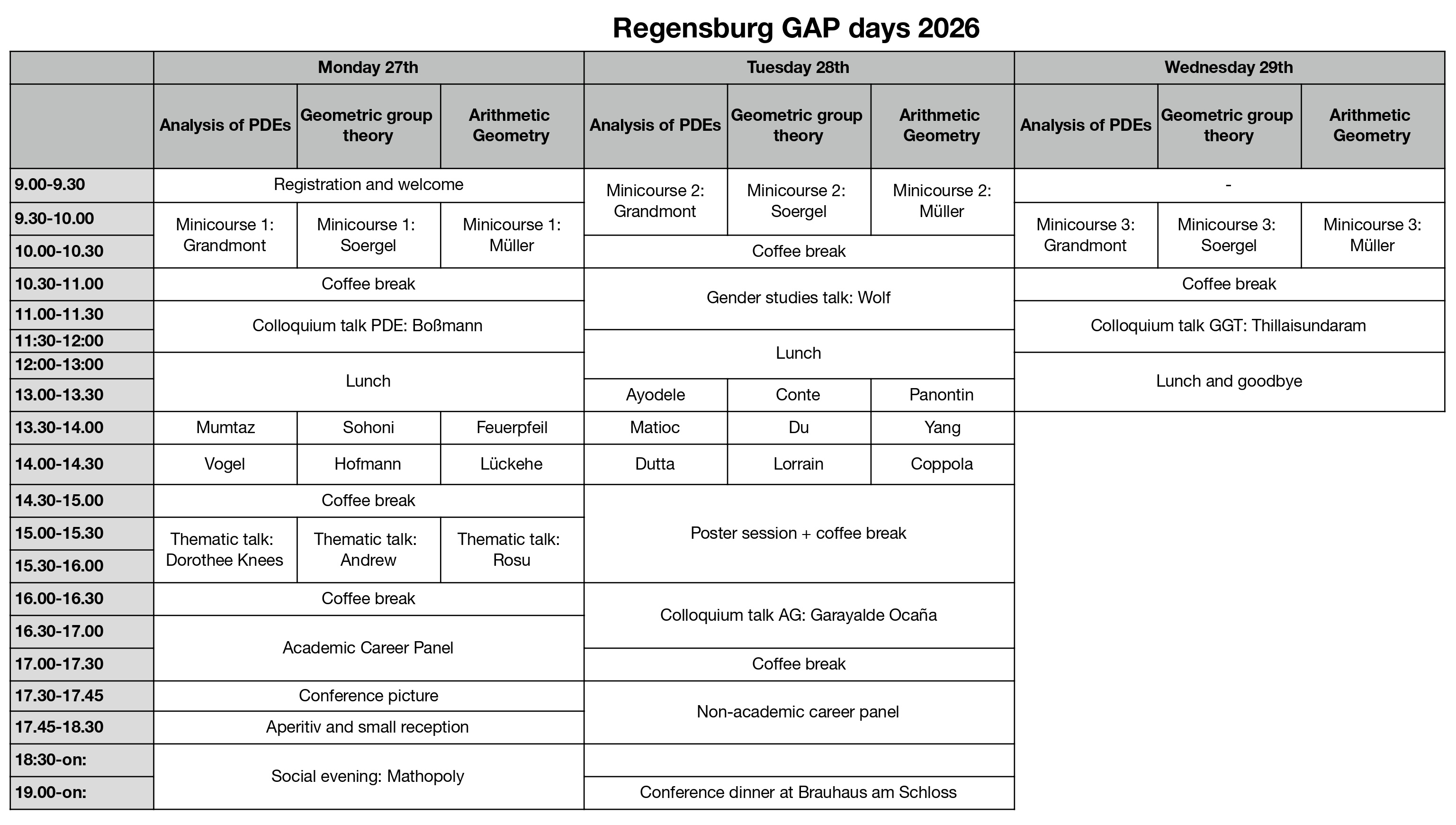
The conference will start at 9am on Monday 27 July and will end at lunch time on Wednesday 29 July.
Abstracts
Minicourse (Soergel)
Title: An introduction to Dyer groups: Coxeter groups, right-angled Artin groups and more…
The goal of this mini-course is to introduce Dyer groups. What are they? Where do they come from? What do we know about them? Dyer groups generalise Coxeter groups and right-angled Artin groups. They first appear (not under that name) in work by Matthew Dyer on Coxeter groups. We will give an overview of known results and mention open questions.
Plenary talk (Thillaisundaram)
Title: New examples of finitely generated branch groups with maximal subgroups of infinite index
The study of maximal subgroups has a long history, with significant results being for example the Margulis-Soifer Theorem, which states that a finitely generated linear group G has maximal subgroups only of finite index if and only if the group G is virtually solvable. Now the family of branch groups is significant within infinite group theory, but also increasingly to other areas of mathematics, such as dynamics, number theory and algebraic geometry. Branch groups are groups acting on rooted trees with a fractal-like structure. The quest to understand when finitely generated branch groups have maximal subgroups of infinite index is a recent venture, with few examples or methods to do so. In this talk, I will outline the known examples and approaches, plus giving some new results.
Thematic talk (Andrew)
Title: Automorphisms behaving badly
Baumslag–Solitar groups are HNN extensions of the infinite cyclic group, whose isomorphism type is controlled by two integers giving the two embeddings. They have provided many counterexamples over the years: for example, they include groups which are not Hopfian and groups which are Hopfian but not residually finite. Later, Collins and Levin showed that there are Baumslag–Solitar groups that do not have finitely generated automorphism group. Moving this construction to higher rank, one can study "Leary–Minasyan groups": these are HNN extensions of free abelian groups, with both inclusions finite index. They are also sources of counterexamples, such as groups which are CAT(0) but not biautomatic. We study their automorphism groups, and in particular characterise when they are finitely generated; this includes some finitely presented metabelian groups with automorphism groups that are not finitely generated. This is joint work with Sam Hughes and Motiejus Valiunas.
Contributed talks
Pranali Sohoni
Title: Detecting Quasi-Isometry via JSJ Decompositions for Right-Angled Coxeter Groups
A right-angled Coxeter group (RACG) is a group generated by involutions with only commuting relations. It has a defining graph where vertices represent generators and edges encode commutation. Classifying these groups up to quasi-isometry is a challenging but important problem. We use a combinatorial approach to resolve this problem for an interesting family of RACGs whose defining graphs are flag-triangulations of the two-sphere. Given such a RACG, our approach helps us combinatorially determine the JSJ decomposition of a certain 3-manifold on which the RACG acts. Comparing these decompositions for two RACGs in the family reveals obstructions to quasi-isometry between them. This is joint work in progress with Annette Karrer.
Yukun Du
Title: Schottky pairs on Trees via Continued Fractions and Axial Geometry
We give a complete criterion for when two hyperbolic automorphisms of a tree generate a free, discrete subgroup. The decision depends only on three geometric invariants: the translation lengths of the generators and the length of overlap of their axes. This data is organized using the continued-fraction expansion of the translation-length ratio.
Andreas Lorrain
Title: Dehn-gerous groups
In 1911 Max Dehn asked the following question: Given a group defined by generators and relations, is there an algorithm that can determine if a word represents the identity? It turns out that this depends on the group. So, suppose that such an algorithm exists for your favourite group. How fast is it? Gromov defined a way to quantify this and called it the 'Dehn function'. One can see this Dehn function as a measure of some sort of complexity of the group. In this talk we will explore some of the subtleties of this problem and consider a special set of groups: the Thompson groups F, T, and V. Are they as Dehn-gerous as they look?
Martina Conte
Title: Concise formulae in groups of non-positive curvature
According to a definition of Philip Hall, a word w is concise in a class of groups C if the verbal subgroup w(G) is finite for every group G in C in which w takes only finitely many values. In joint work with Moritz Petschick we considered a natural extension of the notion of conciseness to first-order formulae in the language of groups and established this property for various classes of formulae and groups. In this talk I will give an overview of this topic and present joint work with Laura Ciobanu where we explore conciseness of formulae in acylindrically hyperbolic groups and in related classes of groups.
Franziska Hofmann
Title: $\ell^1$-seminorm on products
We consider the seminorm on singular homology associated with the basis of singular simplices of the singular chain complex. We study how this seminorm behaves under products. More precisely, the goal is to understand the relationship between the seminorm on homology $H_*(M\times N)$ of a product space and the seminorms on the homology of the factors $H_*(M)$ and $H_*(N)$. This is ongoing joint work with Clara Löh.
Posters
Giovanni Sartori Artin groups and their isomorphism problem
Poppy Azmi Cubulating Coxeter and Shephard groups
Jean-Baptist Bellynck How to go from symplectic geometry into geometric group theory
Leon Pernak Capturing structure of infinite group presentations
Rafaela Ioannou Menger curve boundaries and quotients
Alexis Marchand Stable commutator length and spectrum problems
Talia Shlomovich Non-hyperbolic groups with non-planar Morse boundary
Minicourse (Müller)
Title: Iwasawa theory of graphs
We will Introduce Z_p towers of graphs and explain how these towers resemble phenomena in classical Iwasawa theory such as growth formulae and Iwasawa main conjectures. We will furthermore explain relations to l-functions of algebraic curves.
Plenary talk (Garayalde Ocaña)
Title: Cohomology in action
In mathematics, we frequently study objects by associating them with specific invariants. Examples include assigning a discriminant to a polynomial, a Lie algebra to a group, fun- damental or homotopy groups to a topological space, or volume to a geometric object. This talk focuses on cohomology, an algebraic structure used across many different branches of mathematics. Indeed, cohomology serves as a powerful tool for detecting obstructions and solving pro- blems in many areas, and it is widely studied in topological spaces, algebraic varieties, and arithmetic or topological groups. After (possibly) providing a motivating example in arithmetic geometry, we will narrow our focus to the cohomology of groups. Ultimately, the goal of this talk is to illustrate the challenges of computing cohomology algebras of groups and to highlight the key problems tackled in the field in recent years.
Thematic talk (Rosu)
Title: Special cycles and the Kudla program
Special cycles have been at the heart of the Kudla program in arithmetic geometry, their intersections being related to L-functions and Eisenstein series. I will give an introduction to the topic and discuss in particular some of my joint work with Bruinier and Zemel on smooth compactifications of Shimura varieties. The focus will be on the modularity of the generating series that have the special cycles as coefficients.
Contributed talks
Nirvana Coppola
Title: Torsion points on $\GL_2$-type abelian varieties
In 1977, Mazur proved that there is a finite complete list of finite groups that occur as torsion subgroups of some elliptic curve defined over the rational numbers. After that, a lot of partial progress has been made in order to generalise this result to other contexts, such as for elliptic curves defined over a number field, or for abelian varieties of higher dimension. However, even for abelian surfaces, a complete list of possible torsion subgroups is only known under some assumption on the endomorphism algebra (i.e. having potential quaternionic multiplication). In this talk, I will focus on abelian varieties of $\GL_2$-type and give a generalisation of a theorem of Katz (1981) that can be used to find an optimal upper bound to the size of the torsion subgroup. I will then show how to implement this result to print a list of possible torsion subgroup orders for abelian varieties of $\GL_2$-type over $\Q$ of a given dimension. This is joint work with Jessica Alessandrì (MPIM Bonn).
Julian Feuerpfeil
Title: What Hilbert can tell us about Iwasawa Theory of S-Class Groups
Hilbert’s Theorem 90 is arguably one of the most central results of number theory, with a vast array of generalisations and reformulations. In this talk, we first reinterpret Hilbert’s original statement for finite cyclic Galois extensions in the setting of S-class groups and ask whether it still remains a theorem. We then pass to Zp-extensions of number fields and show that this "Hilbert 90 property" at finite levels can, perhaps surprisingly, control Iwasawa invariants in the limit. We apply this perspective to the Gross-Kuz’min conjecture, obtaining an explicit criterion for its validity. If time permits, I will discuss a heuristic behind this criterion, which -supported by numerical evidence - suggests that it is almost always satisfied in the totally real case.
Tianzhi Yang
Title: Fields of Moduli of Curves of Genus 4
The field of moduli of a variety X over an algebraically closed field K is defined as the fixed field of those automorphisms σ of K for which X\cong X^{\sigma}. A fundamental question is under what conditions a variety admits a model over its field of moduli. Let C be a smooth curve of genus 4 over K, under a mild condition, we give a classification of all possible automorphism groups for which the curve may fail to descend to its field of moduli.
Justina Lückehe
Title: Non-commutative Fitting invariants in equivariant Iwasawa theory
The (zeroth) Fitting ideal of a finitely presented torsion module over a commutative ring is contained in the annihilator of the module, but is generally easier to calculate than the latter. Nickel, Johnston and Kataoka generalised the concept of Fitting invariants to certain non-commutative algebras. Kataoka's theory of shifts of Fitting invariants gives rise to a non-commutative MacRae invariant, which can be regarded as a generalisation of the characteristic ideal in the absence of the classical structure theorem. For Iwasawa algebras of one-dimensional admissible p-adic Lie extensions of number fields, one can prove localisation formulas for the Fitting and MacRae invariant. This theory can then be used to calculate invariants of certain Iwasawa modules which appear naturally in an equivariant Iwasawa main conjecture due to Mejías Gil.
Andrea Panontin
Title: Rigid cohomology in homotopy theory.
Let's fix a field k of positive characteristic and let's consider smooth schemes over k. In order to define a cohomology theory on such objects with coefficients of characteristic zero, one needs to carry out some lifting process. The idea of Monsky--Washnitzer and then Berthelot is to lift the scheme to an object living over a characteristic zero base and to use such lift to define cohomology groups. We will recall some classical results and introduce a possible approach to these ideas in homotopy theory.
Posters
Carolyn Echter Weight filtrations via slopes
Minicourse (Grandmont)
Title: Fluid-structure interaction problems : modelling, existence, and contact issues
Fluid-structure interaction phenomena arise in many applications, ranging from cardiovascular flows to aircraft wing dynamics or micro-swimmer locomotion. The aim of this series of lectures is to present some systems of PDEs describing such phenomena. We will focus on viscous incompressible flows coupled to elastic or rigid structures. First, I will introduce a two-dimensional coupled system that can be considered as a toy model for blood flow in arteries. The fluid and the structure are coupled through interface conditions, and since the structure is moving, the fluid equations are set in an unknown domain, leading to geometric nonlinearities. I will present the main mathematical difficulties arising in the study of strong and weak solutions, and formally derive energy estimates. I will then outline the main steps in proving existence of strong solutions, first locally and then globally in time, as well as existence of weak solutions. The strategy for strong solutions is by now fairly standard, and relies on the study of the associated linearized system, elliptic regularity, and a fixed-point argument. I will explain why such model can lead to no-collision result and then provides global in time existence. For weak solutions, a key step is to establish compactness, for instance via the Aubin-Lions lemma; however, dealing with moving domains and incompressible flows requires some adaptations. Finally, the question of contact — between the structure and the boundary, or between several immersed structures — is investigated. We examine why no-collision results hold for smooth rigid bodies when considering standard boundary and coupling conditions, the physical and mathematical paradoxes this raises, and introduce a new model that resolves this paradox.
Plenary talk (Boßmann)
Title: Effective evolution equations for interacting Bose gases
The dynamics of large interacting quantum systems are described by the Schrödinger equation. However, for any realistic number of particles, this exact description is of limited practical use due to the high dimensionality of the problem, calling for effective descriptions of the dynamics. In this talk, I will give an introduction to the derivation of such effective evolution equations for bosonic quantum systems from first principles. In particular, I will explain the emergence of the non-linear Schrödinger equation and touch on the situation of strong attractive interactions, which lead to a blow-up of the effective PDE.
Thematic talk (Knees)
Title: Analysis and simulation of a rate-independent phase-field damage model
In this talk, the focus is on rate-independent damage models. Since the corresponding phase-field energies in general are non-convex, we are faced with a discontinuous evolution of the phase-field variable. Solution concepts have to be carefully chosen in order to predict discontinuities that are physically reasonable. In the first part of the lecture we give a short introduction to solution concepts for rate-independent systems and illustrate them with an example. We then focus on the concept of balanced viscosity solutions and develop a convergence scheme that combines alternate minimization with a local minimization ansatz due to Mielke/Efendiev, [EM06]. We proof the convergence of the incremental solutions to balanced viscosity solutions and illustrate the behaviour of the numerical scheme with examples, [BRKM22].
[EM06] M. A. Efendiev, A. Mielke, On the Rate-Independent Limit of Systems with Dry Friction and Small Viscosity, Journal of Convex Analysis 13(1), 151-167, 2006.
[BRKM22] S. Boddin, F. Rörentrop, D. Knees, J. Mosler, Approximation of balanced viscosity solutions of a rate-independent damage model by combining alternate minimization with a local minimization algorithm, arXiv:2211.12940, 2022.
[RBKM24] F. Rörentrop, S. Boddin, D. Knees, J. Mosler, A time-adaptive finite element phase-field model suitable for rate-independent fracture mechanics, Computer Methods in Applied Mechanics and Engineering, vol. 431, p. 117240, 2024.
Contributed talks
Ayodele Victoria
Title: Besse-Type Scheme for the Cahn-Hilliard Equation in Two-Phase Flow Computations
Multiphase flows arise in a wide range of applications, including materials science, petrochemical engineering, and the oil industry. Despite their importance, the accurate numerical simulation of multiphase flows remains challenging due to the complex behaviour of the governing equations and the need for stable long-time computations. The key challenges in simulating multiphase flow include the complexity of the equations, computational resources, accuracy, and stability. To address these challenges, we propose a new Besse- type scheme for the Cahn-Hilliard equation (BSCH) and its coupling with the Navier-Stokes equation (BSCH-NS). The proposed scheme is second order in time and linearly implicit, requiring only the solution of a linear system at each time step. The scheme satisfies the energy dissipation law without imposing any condition on time or mesh size, providing unconditional stability. The key objective of the work is to develop a method that accurately preserves the energy law at the discrete level, and also, a method that shows improved long-time behaviour compared to the existing auxiliary variable method. We study the deformation of an initially rectangular bubble with two immiscible fluids using the proposed scheme, with the interface described by the level curve . The interface evolves under surface tension, driving the phase separation dynamics. The proposed method is compared with the existing auxiliary variable methods to investigate the long-time behaviour of the numerical solution. Numerical experiments are implemented in FreeFEM and MATLAB. The proposed method provides an improved numerical solution that is accurate and stable over a long-time computation, contributing to a better prediction of multiphase flow behaviour in industrial applications.
Shilpa Dutta
Title: A variational approach to ferronematics
Ferronematics are complex materials which are suspensions of magnetic particles in a medium of nematic liquid crystals. These materials may have potential ap- plications in display technologies and devices based on magnetic switching. We present a variational approach to ferronematics in a three dimensional setting. The ferronematic energy functional is described by two established theories: the Landau-de Gennes energy to explain the nematic part, the micromagnetic energy to explain the magnetic part, and coupling energies between them. We explicitly include the nonlocal stray field energy in a bulk setting and the coupling energy accounting for the nematic and stray field interaction. We prove the existence of an energy minimizer for the introduced ferronematic energy functional in a bulk setting. We then provide a reduced local ferronematic energy in a thin-film set- ting via Γ-convergence. We then discuss the key aspects, e.g. the existence and uniqueness results to the ferronematic energy functional obtained in a thin-film setting. We present the influence of a stray field on the defect localization of stable ferronematic profiles obtained via the Crank-Nicolson finite difference method, for details see [1, 2].
[1] Shilpa Dutta, James Dalby, Apala Majumdar, and Anja Schlömerkemper. A study of ferronematic thin films including a stray field energy. arXiv preprint arXiv:2509.10442, 2025.
[2] Shilpa Dutta. A variational approach to ferronematics with a dimension reduc- tion. arXiv:2606.01430, 2026.
Hanifah Mumtaz
Title: Towards Effective Models for Nematic Suspensions: Interaction of Liquid Crystals with Rigid Bodies
Einstein's effective viscosity formula for dilute suspensions of rigid spheres is a classical result in fluid mechanics. For nematic liquid crystals, however, even describing the interaction between a single rigid body and the surrounding fluid is already nontrivial, because the flow is coupled to a director field describing molecular alignment. In this talk I look at that stationary interaction problem in a simplified Ericksen–Leslie setting. The model combines incompressible Stokes flow, rigid-body kinematics, and a Ginzburg–Landau approximation for the director field. A key observation is that a Korteweg transformation allows the momentum equation to be rewritten as a stationary Stokes system with modified pressure. This provides a convenient way to formulate the weak force and torque balance on the body boundary. I will then discuss an existence result for weak stationary solutions, obtained by the direct method in the calculus of variations. The broader aim is to prepare the ground for future effective descriptions of suspensions in nematic solvents.
Cornelia Vogel
Title: Macroscopic Thermalization for Highly Degenerate Hamiltonians After Slight Perturbation
A closed macroscopic quantum system thermalizes if its initial state reaches a suitable equilibrium subspace and stays there for most of the time. A sufficient condition for the thermalization of all initial states is the eigenstate thermalization hypothesis (ETH). Tasaki recently proved the ETH for a perturbation of the Hamiltonian of free fermions on a one-dimensional lattice. The perturbation is needed to remove the high degeneracy of the Hamiltonian. First, we prove the ETH also for the unperturbed Hamiltonian. Second, we show that in general if a Hamiltonian has one eigenbasis in equilibrium, then after adding a small generic perturbation it satisfies the ETH and thus all states thermalize. This is joint work with Barbara Roos, Shoki Sugimoto, Stefan Teufel and Roderich Tumulka.
Anca Matioc
Title: Analysis of a two-phase model describing the growth of solid tumors
In this talk we consider a two-phase model describing the growth of avascular solid tumors when taking into account the effects of cell-to-cell adhesion and taxis due to nutrient. The tumor is surrounded by healthy tissue which is the source of nutrient for tumor cells. In a three-dimensional context, we prove that the mathematical formulation corresponds to a well-posed problem, and find radially symmetric steady-state solutions of the problem. They appear in the regime where the rate of cell apoptosis to cell proliferation is less than the far field nutrient concentration. Furthermore, we study the stability properties of those radially symmetric equilibria and find, depending on the biophysical parameters involved in the problem, both stable and unstable regimes for tumor growth. (Joint work with Joachim Escher, Hannover)
Posters
Lukas Reichmann On the spherical symmetry and finite-range assumptions of the interaction potential in the low energy study of dilute Bose gases
Cedric Igelspacher Typicality of Thermal Equilibrium
Anna Simon Existence of mild solutions to the volume-preserving Allen–Cahn equation and their asymptotic behavior
Plenary talk
Title: From unique value to greater visibility: Elevating women in mathematics
Women in mathematics make essential contributions to science, innovation, and society. They bring diverse perspectives, research questions, and approaches that enrich the discipline and broaden its impact. However, the unique value of women in mathematics is often not sufficiently recognized—neither by women mathematicians themselves nor by academic institutions—which can limit efforts to foster and invest in their visibility. This talk explores why visibility matters, discusses challenges related to the contemporary visibility imperative, and introduces the concept of doing visibility as a framework for actively shaping professional presence. Drawing on recent research and practical examples, the presentation offers strategies for women mathematicians to strengthen their visibility and influence within academia and beyond.